'The logical step is to challenge the very legitimacy of the Chinese claim over Tibet,' recommends Inspector General Gurdip Singh Uban (retd).

The exercises also involve combat operations command, combat synergies, live fire shooting training, and comprehensive inspection of arms integration, the report said.
The commanders will also deliberate on the overall situation in Jammu and Kashmir besides delving into issues having national security implications, they said. However, the main focus will be on the situation in eastern Ladakh where Indian and Chinese troops are locked in an eyeball-to-eyeball face-off in Pangong Tso, Galwan Valley, Demchok and Daulat Beg Oldie, the sources said.
The creation of a CDS has got the head right. Issues that were not talked about for years are now being discussed, points out Ajai Shukla.
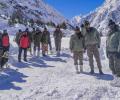
The bodies of the last four of the trapped labourers were pulled out from the site of the avalanche-hit Border Roads Organisation (BRO) camp in Chamoli on Sunday, taking the death toll to eight as authorities ended the nearly 60-hour rescue operation.

'All the government needs to do is to identify clear political and strategic objectives and to give the military planners a free hand,' asserts Ajai Shukla.
China and India have agreed to work to maintain peace along the Line of Actual Control and resolve the border standoff through talks while implementing the consensus reached between the two countries' leadership that 'differences' do not escalate into 'disputes', a top Chinese official said.
The Indian side is expected to present specific proposals at the talks to deescalate tension in Pangong Tso, Galwan Valley and Demchok -- the three areas in eastern Ladakh where the two sides have been on a bitter standoff for last one month, the sources said.
The Chinese authorities have been rapidly building defence infrastructure along the Line of Actual Control, indicating that they are preparing for a long period of tension with India, points out Jayadeva Ranade, the former senior RA&W officer and China expert.
The two sides have already held at least 12 rounds of talks between local commanders and three rounds of talks between major general-rank officials but no positive outcome came out from the discussions, they said.
The government needs to answer the critical question of whether it has accepted any restrictions on its infrastructure creation activities, asserts Ajai Shukla.

Major General Sujan Singh Uban, a legendary veteran of the Second World War, was a natural choice to raise, train and command the Special Frontier Force and mould them into a well oiled fighting machine, recalls his son Inspector General Gurdip Singh Uban (retd), who led SFF troops during the Kargil War.

The Chinese have just one commander for all the forces confronting India. Commanders of all these forces answer to one man, and one headquarter. India, on the other hand, offers a diversity of options that is a military embarrassment in the 21st century. In Arunachal and Sikkim-Bhutan, the Eastern Army Commander is in charge. In the Uttarakhand (central) sector, it will be the Central Army Commander. The Himachal-Tibet border is the domain of the Western Army Commander. And all of Kashmir and Ladakh further on, the Northern Army's. Effectively, an array of at least eight 'three-star' commanders will be arrayed against one Chinese, says Shekhar Gupta.

The "bumper" 40 per cent increase followed a number of sweeping reforms intended to transform the "bloated People's Liberation Army, into a more modern, nimble fighting force".

The naming of the places in memory of the soldiers comes days after Chinese military commander Qi Fabao, who was injured in the Galwan Valley clash with Indian troops in June, 2020, attended the ruling Communist Party of China's (CPC) Congress as a delegate.

The visit comes a week after 20 Indian Army personnel were killed in a brutal assault by the Chinese military in Galwan Valley which escalated the border tension.
Currently, the reserve forces are under the dual leadership of military organs and local Communist Party committees and they would be brought under the control of the ruling party and the CMC from July 1, the state-run Xinhua news agency reported.

Army chief General Naravane said the ongoing dialogue will sort out all the perceived differences between the two countries.

The talks came a day after the two armies began a limited disengagement in a few areas in Galwan Valley and Hot Spring in a demonstration of their intent to end the row peacefully.
The talks between the two armies are going to be held this week at multiple locations including Patroling point 14 (Galwan area), Patrolling point 15, and Hot Springs area, top government sources said.

The visit is also aimed at boosting morale of the army personnel engaged in the seven-week bitter border faceoff with the Chinese troops in the region, sources added.
The operational alert allows troops to get acclimatised to high altitudes, renovate the bunkers and trenches from which they would fight, break out ammunition, and carry out the coordination needed to fight an integrated defensive battle.
Gen Naravane reviewed the overall security situation in the region with Northern Army Commander Lt Gen Yogesh Kumar Joshi, commander of the 14 Corps Lt Gen Harinder Singh and other senior Army officials.
Sources said the process of disengagement along the Line of Actual Control is "complex", and in such a context, speculative and unsubstantiated reports need to be avoided.
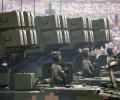
The first priority for the new Tibetan administration in Dharamsala should be to look at Tibetan recruitment in the PLA, suggests Claude Arpi.

The high-level talks came a week after 20 Indian Army personnel were killed in a violent clash between the two sides in Galwan Valley.

China plans to build a new highway along the Line of Actual Control (LAC) with India as part of Beijing's efforts to strengthen its strategic position and project its power, a media report said on Wednesday.
The Indian delegation led by Lt General Harinder Singh, the general officer commanding of Leh-based 14 Corps, and Commander of the Tibet Military District Maj Gen Liu Lin held an extensive meeting in Maldo on the Chinese side of the Line of Actual Control in eastern Ladakh on Saturday that began at around 11.30 am and went on till evening.

The Chief of the Army Staff interacted with almost all the injured soldiers and complimented them for their bravery.

'There are major implications for India. Though there was a transparently thin attempt to project the troop reduction as intended to promote peace, the downsizing is actually part of plans to streamline and strengthen the PLA, capable of defending China's national interests at home and abroad,' says Jayadev Ranade.

'The government will ensure that India's pride is not affected as far as the situation along Indo-China border is concerned'
The meeting will take place in Chushul sector on the Indian side of Line of Actual Control.
One hopes the new Lok Sabha will mark a break from a dismal tradition -- lack of interest in defence and security policies, argues Colonel Anil A Athale.
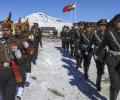
The decision to disengage the forces, locked in a bitter standoff for the last six weeks in eastern Ladakh, was taken at a nearly 11-hour-long meeting between senior Indian and Chinese commanders in Moldo on the Chinese side of the Line of Actual Control (LAC) on Monday.
This is the third round of Corps Commander-level talks being held. The first two rounds had taken place in Moldo on the Chinese side of the LAC.

The exercise was aimed at validating joint plans for strategic airlift of specialised forces employing IAF's fixed and rotary wing platforms by landing and dropping in designated areas for undertaking kinetic actions, they said.

'The greatness of India can be experienced by meeting Indians on the frontiers of India.' 'Every citizen on the border is a soldier'
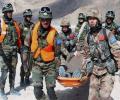
This is the first such incident along the border with China that Indian armed forces personnel have been killed after a gap of nearly 45 years.
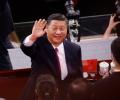
Xi arrived at the Nyingchi Mainling Airport on Wednesday and was warmly welcomed by local people and officials of various ethnic groups, Xinhua news agency reported.
The focus of the deliberations was on finalising modalities for disengagement of troops in eastern Ladakh.
